Thursday, April 17, 2014

Mumbai (formerly Bombay), India

We arrived in Mumbai on Wednesday, April 9th for a much anticipated overnight visit.  With a population of over 20 million people, Mumbai is the most populous city in India and is known as the "Gateway to India".  It is a massively congested city with over 8,000 taxis and 1,500 tuk-tuks jamming the streets along with overcrowded public buses and private tourist buses.  As we entered the harbor, we could see the iconic Gateway to India arch on the waterfront and the famous Taj Mahal Hotel from the deck of the ship. 

In the afternoon, we took a tour to visit the Caves of Elephanta which is an archaeological site of ancient temples that were carved into a mountainside in the 7th century.  We took a 90 minute ferry ride across the harbor to the island of Elephanta, then a short train ride to the staging area for climbing to the top of the mountain to the entrance of the cave.  In spite of the heat, we managed the climb up 125 steps okay, but the peddlers along the way were a challenge.  Also, there were wild monkeys along the trail and a few sacred cows.  It was well worth the climb as the amazing ancient carvings were unbelievable.  We spent some time marveling at the intricate carvings inside the caves.  Apparently, there are a number of other cave temples like this in the area.  Along the descent we purchased some souvenirs, then enjoyed a cold Kingfisher beer at a cafĂ© at the bottom of the mountain.  As we were having our beers, a cow stopped by to check us out.  It is funny how they wander among the people so nonchalantly.  We enjoyed a cooling ferry ride back to the mainland and returned to the ship.

On our second day in Mumbai, we took a whirlwind guided tour of the City.  On our tour we passed by several famous sites, including Victoria Terminus Railway (the neo-Gothic railway station built in 1888); Crawford Market (a bustling market in existence since 1867); Marine Drive and Chowpatty Beach (the upscale area of town facing the bay that looks a lot like Bayshore Boulevard in Tampa); Malabar Hill (upscale residential area); Hanging Gardens (botanical gardens); Towers of Silence (where the Parsi religious sect bury their dead in open tombs for vultures to eat the bodies - very gruesome); Jain Temple (where the religious sect believes all life is sacred so they don't eat meat or any vegetables that grow below the ground and they don't even kill insects and their orthodox members don't wear any clothes); the house where Mahatma Ghandi stayed for years when he visited Mumbai; and several other historic sites.  This tour went so fast and took in so many sites it was a challenge taking pictures, but we were glad to see so many things and learn from our tour guide!

Of particular interest to tourists in Mumbai is the unique laundry service in the City.  There are several "ghats" around the City where men (not women) provide a laundry service to residents of Mumbai.  A service picks up the dirty laundry from your house in the morning and takes it to the washing ghats (outdoor concrete washing tubs) where clothes are soaked, scrubbed and pounded, then hung out to dry.  Then, the men press the clothes with big heavy irons.  Remarkably, sheets and other linens come out snowy white in spite of the murky looking water.  The clothes are then delivered back to your home the next morning, ready to wear.  The cost is 12 rupees (20 cents) per piece.  On our tour, we visited the famous Dhoubi Ghat Laundry Service.  That was an eye opening stop.  The traffic at the bridge overlooking the place was total chaos with cars, buses, motorcycles, tuk-tuks, pedestrians, dogs and many, many peddlers and beggars all jammed together.  We were warned by our tour guide to not make eye contact with any of the beggars and peddlers who are all professional pickpockets and scammers -- even the children. They are known as the "Peddlers Mafia", an organized criminal enterprise. We saw two small children, probably 4 and 6 years old, running barefoot in and out of the traffic posing for pictures and begging for attention.  Their goal was to get a tourist to pull out a wallet so they are targets for a pick.  It was tough to watch these small, unattended children at work in such a dangerous environment.  It's tempting to give them money to get them off the street.

Another disturbing site was to drive by a 28-story high rise home owned by the wealthiest man in India.  It is occupied by his extended family.  The lower floors of the building are the garages where he keeps his 138 automobiles!  Yet, this "over the top" opulent home overlooks some of the worst shanties and slums we have ever seen.  There seems to be an acceptance of the different classes that is hard for us Westerners to understand.

Most of the people we met in Mumbai speak English.  The women wear the most beautiful clothes.  The jewel toned colors of their saris and scarves look so vibrant against their dark skin and hair. 
Also, we learned how strong the family ties are.  Although arranged marriages are still the norm here, it is not as restrictive as we thought.  Rather, the families participate in the courting process by approving or disapproving of the potential mate in an elaborate dating and vetting scheme.  Consequently, the divorce rate is much lower than in other countries of the world.  Their close knit families stay together and work out their problems together.

One other custom unique to Mumbai is the use of the "dabba wallahs" (food men) each day to deliver lunches to the workplaces.  Apparently, men prefer to eat home cooked meals for lunch each day so women prepare elaborate lunches during the morning hours.  There is a service that is offered where food men pick the lunch boxes at the homes and deliver them to the men at their offices or shops, then return the empty lunch boxes back to the homes in the afternoon.  It is a complicated distribution system.  Most of the food men cannot read so they rely on their incredible memories to get the deliveries right each day and they have an incredible accuracy rate.

India is a bewildering country and Mumbai is a microcosm of its diversity with everything from fashionable villas, large luxury hotels, stately colonial buildings, busy commercial streets and extreme poverty and extensive slums. With our three stops in India, we feel like we got a great introduction to the culture of this fascinating country.  We certainly enjoyed the delicious food and meeting the friendly people.  We hope we can return here some day in the future.
Hazy skyline of Mumbai

Gateway to India

Taj Mahal Hotel

Ferry boat to Elephanta Island

 
Train to the ancient cave temples walk-up area
 

Wild monkeys along the trail
 
 Sacred cows
 
Entrance to the mountainside Caves of Elephanta

Inside the caves

Beautiful ancient carvings from 7th century

 Cold beer at the end of the hike
Mumbai
 
Marine Drive in Mumbai
 
8,000 taxis in Mumbai

Home of the richest man in India (28 stories)

Dhoubi Ghat Laundry 
 
Dhoubi Ghat washing tubs

Clean laundry at Dhoubi Ghat

Above the slums at Dhoubi Ghat

Members of "The Mafia"
 
From India, we sail across the Arabian Sea to Oman to begin our Middle Eastern adventure. 

Monday, April 14, 2014

Goa, India

After our amazing tour of Cochin, we were very excited for our second stop on the west coast of India in the State of Goa.  Unfortunately, this stop was a short day so it was a challenge to arrange much sightseeing.  Many of our fellow passengers chose to tour the historic city of Old Goa and visit several churches, but we were interested in going to a beach.  Since we had to be back on board the ship by 2:30 and we were docked too far south of the major, well known beaches, we decided to hire a taxi and take a drive out to the local beaches located closer to the port.  This area is known as "Golden Goa" for its beautiful beaches, but due to our time constraints and a language barrier with our taxi driver, we ended up taking a harrowing ride out to two lesser known beach areas to the south of where we were docked.  The scenery along the way was unremarkable as we dodged other cars, motorcycles, pedestrians and, of course, the occasional "sacred" cow in the road. 

The first beach we visited was Bogmalo, a crescent shaped golden sand beach on the Arabian Sea with a couple of small hotels and a few beach vendors.  We took a walk along the beach and waded into the water to cool off.  There was a little too much trash around and too many dogs running loose on the beach for us to hang out there for very long.  The taxi driver took us to another beach called Baina where we looked around a bit and took in the scenery looking out at the Arabian Sea, but it was also too dirty to enjoy a swim.

We returned to the ship and immediately jumped in the shower!  Our visit here was somewhat disappointing, but there is value in seeing the various parts of India.  We look forward to our upcoming stop in Mumbai.
Dancers welcome us to Goa

Bogmalo Beach in Goa

Bogmalo Beach 
 
Bogmalo Beach on the Arabian Sea
 
Baina Beach in Goa
 
NEXT STOP -- MUMBAI.

Saturday, April 12, 2014

Cochin, India

We prepared ourselves for our visit to India by reading our guide books and attending some onboard lectures.  Brian has also done some reading on the colonial history of India recently.  However, the best advice we received about visiting India was..."you cannot apply western values to what you see in India".  In other words, it is so culturally different from our way of life, you have to open up your mind in order to see the magic of this subcontinent.  This advice was so true!

Our first stop was in Cochin, a port city located in the State of Kerala on southern India's Malabar Coast facing the Arabian Sea.   Cochin has an interesting colonial history of exploration and settlement by the Portuguese, the Dutch and the British (in that order).  For our visit, we went on a long day's private tour arranged by two friends from New York, Kyle and George. 

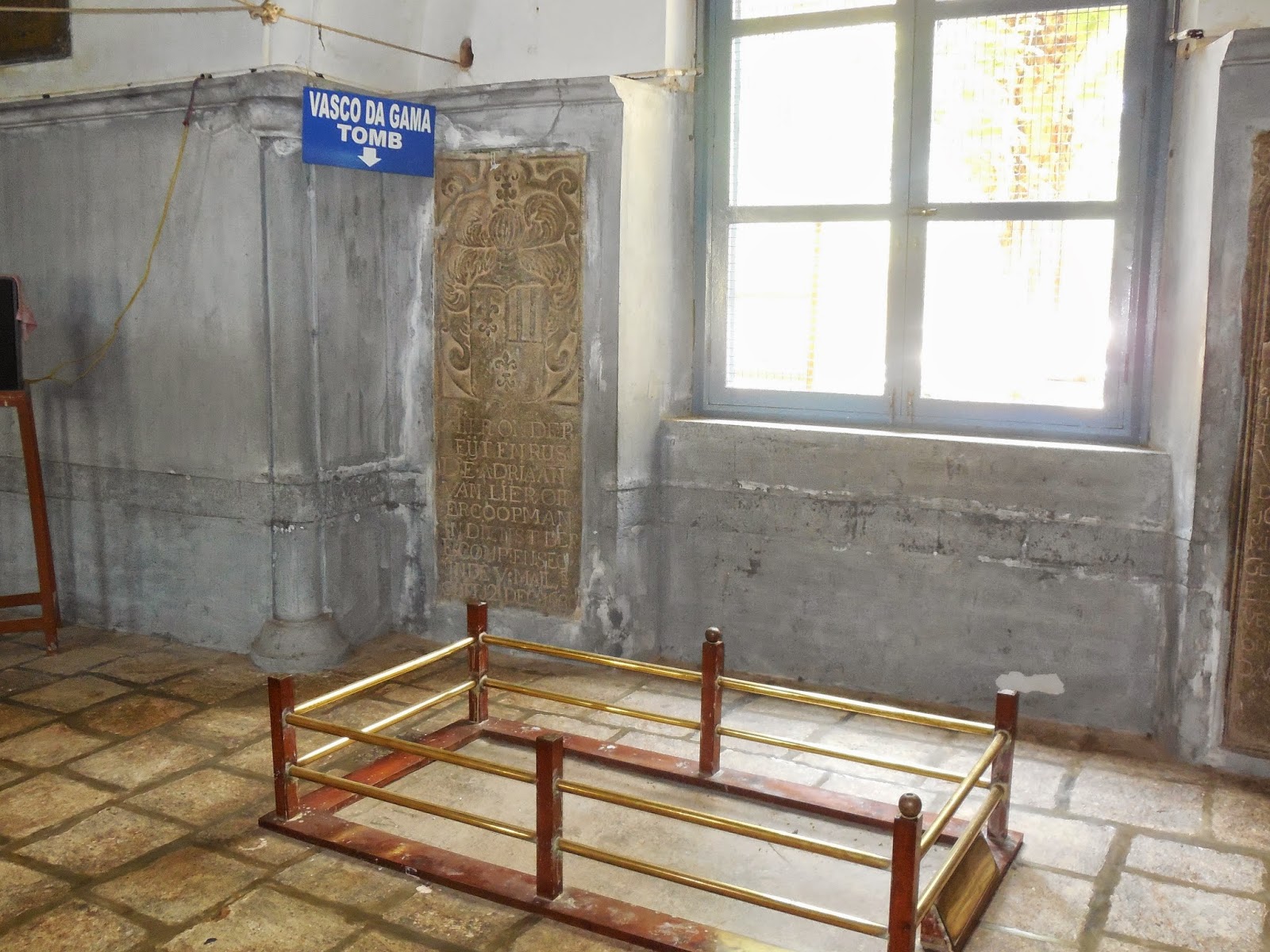
In the morning, we hopped into a van with a tour guide named Markose and a driver that picked us up on the pier.  We traveled around historic Fort Cochin visiting key sites.  We stopped at the Dutch Palace (a historic building with a great regional museum); Jew Town (an area settled  by Jewish traders in the 1500's); a Jewish synagogue built in 1568; a market and fishing area along the waterfront where we saw a very cool demonstration of the large ancient Chinese fishing nets still in use today; and a historic church where the Portuguese explorer Vasco de Gama was originally entombed.  It was a great tour of this interesting area and our tour guide was very informative.

Next, we drove out of the City about an hour and one-half to Alleppey (known as the "Venice of the East") where we boarded a houseboat for a tour of the backwaters of the area to learn about the local villages along the waterways and lake.  It was a crazy drive out of town and was frightening at times because driving in India is absolute chaos.  Our driver did a great job of getting us to Alleppey without incident although there were a number of close calls!!  Our beautiful vintage houseboat had 2 bedrooms with en suite bathrooms, a kitchen and seating area with a dining table on the front.  We cruised the river, canals and lake for over 3 hours watching the villagers as they fished, washed clothes, bathed and swam in the local waters.  It was a very interesting glimpse into the rustic village lifestyle.  It was a beautiful Sunday afternoon on the water so there were lots of houseboats out on the water full of tourists and locals enjoying the day out.  Everyone was friendly and waving as we went past.  The chef on our houseboat served us an incredible lunch of local Indian cuisine including meat and vegetable curries and Kingfisher beer.  We all enjoyed the feast and good company of our enthusiastic tour guide and his assistants.

After the boat trip, we had a harrowing drive back to the ship.  We got caught in a massive traffic jam near the ship due to a visit from a political candidate that necessitated closing a bridge for a time.  Cars, motorcycles, buses, tuk-tuks and trucks were all trying to get across the clogged bridge at the same time.  It was a wild bridge crossing.  Fortunately, we had a late sailing that night so we had plenty of time to get back to the ship.  It was an extraordinary day in Cochin for us with some terrific fellow "Worldies" and a wonderful tour guide.  It was a truly memorable introduction to magical India.
Chinese fishing nets along the waterfront

Cochin's colorful waterfront
 
Even the logging trucks are colorfully painted

Playful school children touring the Dutch Palace
 
The shops in Jew Town
 
Oldest working synagogue in the British
Commonwealth
 
Fisherman pulling up the Chinese fishing nets
while we were perched on the platform
 
Chinese fishing net coming out of the water
 
Chinese fishing net catch
 
Our knowledgeable tour guide, Markose
 
Marketplace in Fort Cochin
 
St. Francis Church in Fort Cochin
 
Vasco de Gama's Tomb
 
Houseboat on the backwaters
 
Us with fellow Worldies, George and Kyle -
Happy Tourists
 
Washing Day
 
Friendly locals
 
A feast of local cuisine - Yummy!!!

Fishermen taking their nets out for the night
 
 NEXT STOP -- GOA, INDIA


Wednesday, April 9, 2014

Colombo, Sri Lanka

From Thailand we sailed southwesterly across the Bay of Bengal down to Sri Lanka (formerly, Ceylon), located off the southern coast of India.  This island nation is slightly smaller than Ireland, but is occupied by 21,000,000 people.  Almost 5,000,000 people per day come into the port city of Colombo for work each day so it is a bustling area.  There are over 8,000 taxis in the City called Tuk-Tuks which are small, open 3-wheel vehicles. 

We looked forward to this stop on our world cruise because Brian's father spent some time here during World War II in the Royal Navy when it was part of the British Commonwealth and was called Ceylon.

We took a tour of Colombo that drove us by a busy, seemingly endless marketplace called the Pettah Bazaar, a colorful Hindu temple, an upscale residential area known as Cinnamon Gardens (named after the spice trades of yesteryear), and a public monument commemorating Sri Lanka's independence from Britain.  We visited the national museum which was very interesting.  At the museum there were several groups of students touring the museum.  They were dressed in their school uniforms and their female teachers were in their colorful saris.  The children all greeted us with "hello's", "goodbyes" and "what is your name?".  They were very engaging and fun as they giggled at our responses.

Next, we stopped at the beautiful Taj Samudra Hotel and enjoyed tea and a snack in the rooftop restaurant overlooking the beach area facing the Indian Ocean.  Our last stop was a visit to Gangaram Temple, a Buddhist temple that was filled with colorful statues and shrines.

This stop in Sri Lanka was a good transition for us offering a cultural change from southeast Asia before we get to India.  The City of Colombo is divided into 15 distinct districts.  Colombo 1 which included the Pettah Bazaar area was very "third world" with considerable poverty.  Colombo 3 and Colombo 7 were just the opposite with modern office buildings and 5-star hotels and shopping areas.  Sri Lanka is rich in natural resources and is definitely a developing area.  Our tour guide told us they are working on a beautification program in Colombo to attract more foreign investment which was evident to us.  The Chinese have built a sports arena in the city center and the large port was extremely busy with containers and cargo ships from all over the world.
Skyline of Colombo

Busy industrial port


Hindu Temple in Colombo

Tuk-Tuk
Independence Square

Independence Square


Throne of the last King of Sri Lanka

National Museum

Enjoying a snack at the Taj Hotel

View of the beach and Indian Ocean


Next stop - Cochin, India.